
Before You Build an AI-Powered Agency, You Need to Get Your House in Order
I see it constantly with my coaching students. Someone discovers agentic workflows, gets excited, and immediately tries to point an...



I see it constantly with my coaching students. Someone discovers agentic workflows, gets excited, and immediately tries to point an AI model at their business. Within a week, they're frustrated. The AI is producing inconsistent outputs, missing client context, and generally making a mess of things. They blame the tool. But the tool is not the problem.
The problem is that they handed a powerful system a disorganized operation and expected it to sort everything out. It does not work that way. AI does not fix chaos. It amplifies whatever it is given. If your foundation is shaky, adding AI to the mix compounds your problems instead of solving them.
I have been building agentic workflows into my own agency operations and teaching my coaching students to do the same. What I have learned through that process is that there are three foundational layers you need to have in place before you even think about automating a single task. Get these right first, and AI becomes genuinely transformative. Skip them, and you are going to waste a lot of time and money going in circles.
This sounds almost too basic to mention, but it is the thing I see most agencies get wrong. Your folder and file structure needs to be logical, consistent, and navigable, not just for your team, but for the AI agents that will eventually be working through it.
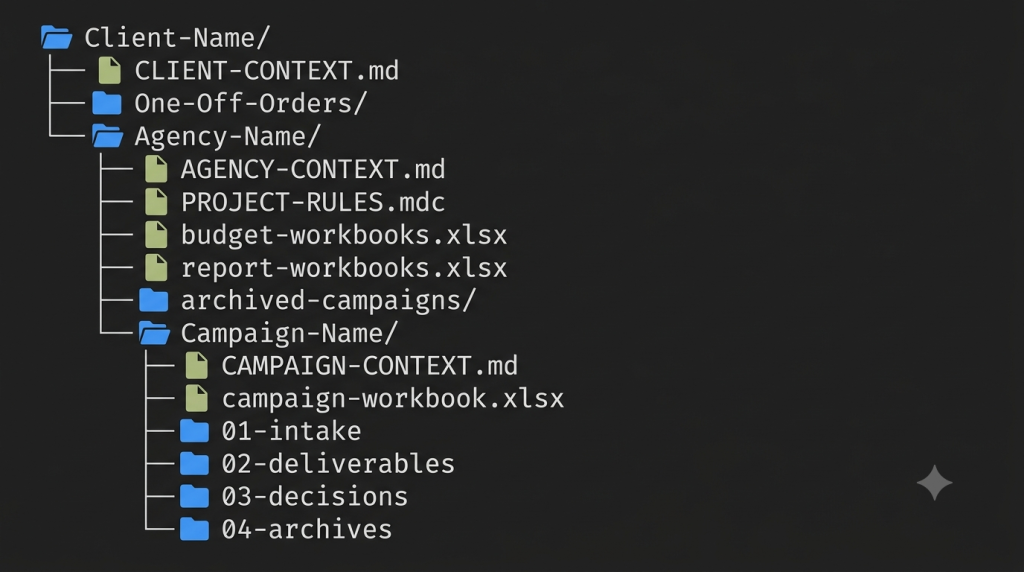
I use Cursor as my harness for building and running agentic workflows. Across my agency, I am managing over 200 monthly campaigns through that system. The only reason it works at any kind of scale is because the underlying folder architecture is clean and consistent. The AI can find what it needs without getting lost, and so can any human on my team.
The framework I have been implementing is called the Interpretable Context Methodology, developed by Jake Van Clief (Clief Notes Skool Community). The core idea is that you have to think of your agency as a system first, and then build your file structure to reflect that system. Every folder, every file, every naming convention should be purposeful. Nothing arbitrary.
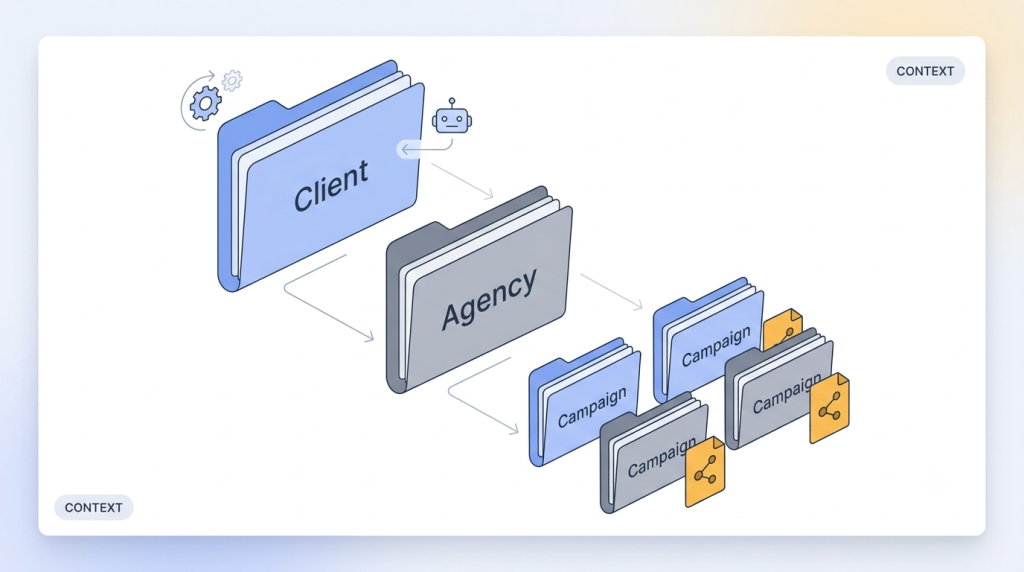
When you get this right, something important happens. The AI agent can move through your client data efficiently because the structure is predictable. There are no dead ends, no orphaned files, no folders that made sense six months ago but are a mystery now. It becomes a shared language between your human personnel and your AI agents, and that shared language is what makes collaboration between the two actually functional.
The second foundational layer is the second brain system, and it serves two distinct but equally important purposes.
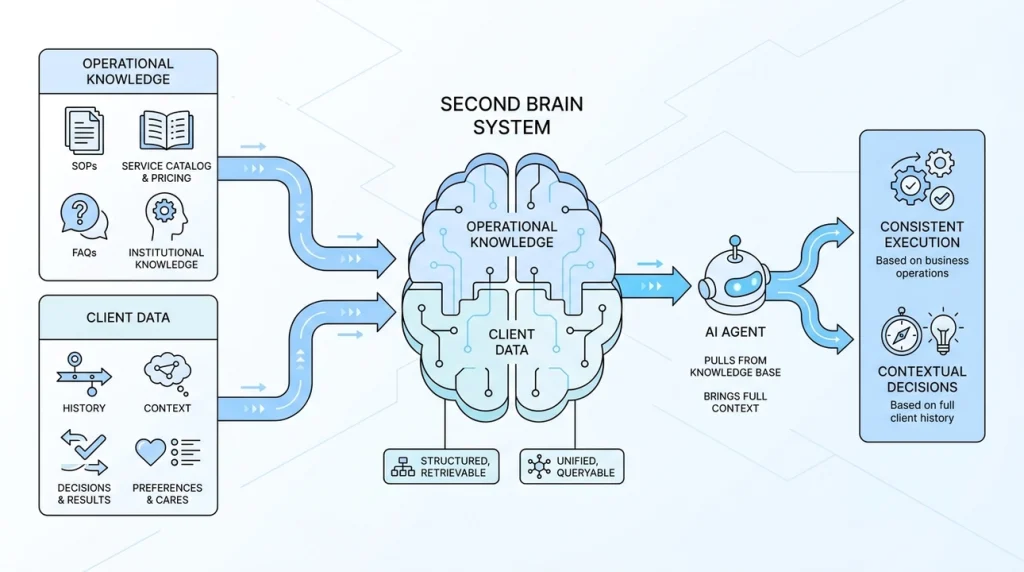
The first purpose is operational. Your second brain should house your SOPs, your service catalog, your pricing schedules, your FAQs, the institutional knowledge that lives in your head or in scattered documents across your team. Getting all of that into one structured, retrievable location is a prerequisite for working with AI effectively, because the AI needs to be able to pull from that knowledge base to make decisions and execute tasks in a way that is consistent with how your business actually operates.
The second purpose is as a unified customer database. This is the part that I think most agency owners underestimate. When an AI agent is working on a client campaign, it needs more than just the current state of that client. It needs the history. It needs the context that led to where things are today. What has been tried, what worked, what did not, what the client cares about, what decisions were made and why.
If that information is scattered across emails, Slack threads, random Google Docs, and individual team members' memories, the AI cannot retrieve it in any meaningful way. But if it is unified in a structured, queryable system tied to each client record, the AI can bring full context to every task it touches. That is the difference between an AI that feels useful and one that feels like it is constantly starting from zero.
Once your structure and your knowledge base are in place, the next step is to look at your actual workflows. And here is where I want to be direct: do not try to automate a broken process. A bad workflow that a human executes imperfectly becomes a bad workflow that an AI executes at scale. That is not progress.
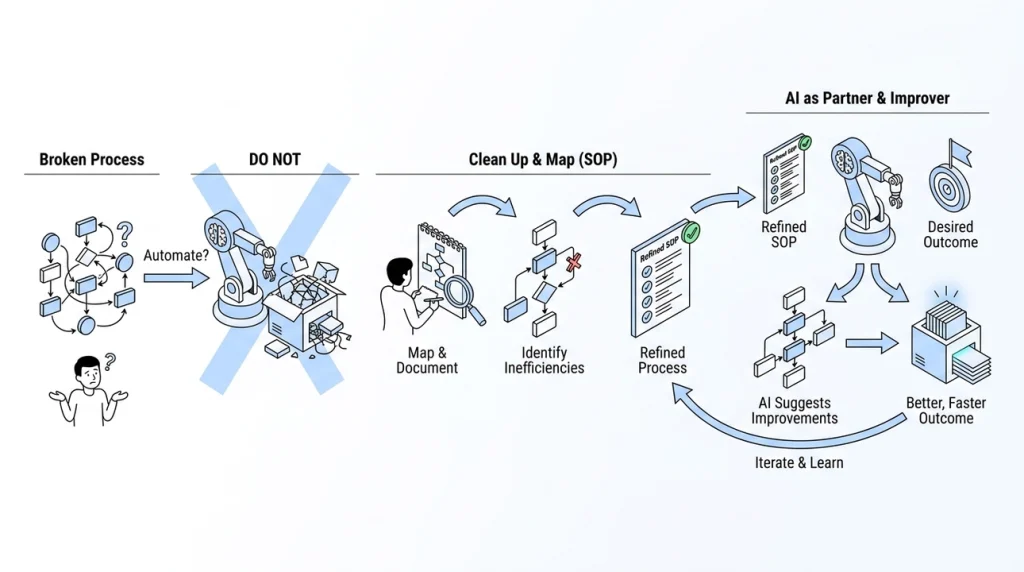
Before you assign any task to an AI agent, map it out in SOP format. Document how the work currently gets done, step by step. This exercise alone often surfaces inefficiencies you have been living with for years without realizing it. The act of writing a process down forces clarity that a vague mental model never demands.
But here is the part that surprised me when I first started doing this work, and it is the insight I find myself sharing most often now. When I started handing SOPs to AI models, I initially treated the process as sacred. Here is exactly how we do this, now automate it. What I found is that this is actually the wrong approach, or at least an incomplete one.
The models are capable enough now that if you give them the SOP and then also give them the desired outcome and the freedom to deviate from your documented process in the interest of efficiency, they will often improve on your SOP. They will find steps that can be combined, identify redundancies, or suggest a sequencing that gets to the same result faster. My workflows, as they exist today, are better than the SOPs I started with, because I trusted the model during the planning stage to treat the process as a starting point rather than a constraint.
This is a real mindset shift. Most people think of AI as an executor: give it a task, it does the task. What I have found is that it functions better as a process improvement partner, at least when you give it the room to play that role. The key is that your SOP needs to be producing a reliable, repeatable, desired outcome before you let the model iterate on it. You cannot hand it a broken process and ask it to make it better. You have to show up with something that already works, and then let the AI find ways to make it work even better.
I want to come back to where I started, because I think it is worth being direct about this. The biggest mistake I see agency owners make is jumping into AI implementation 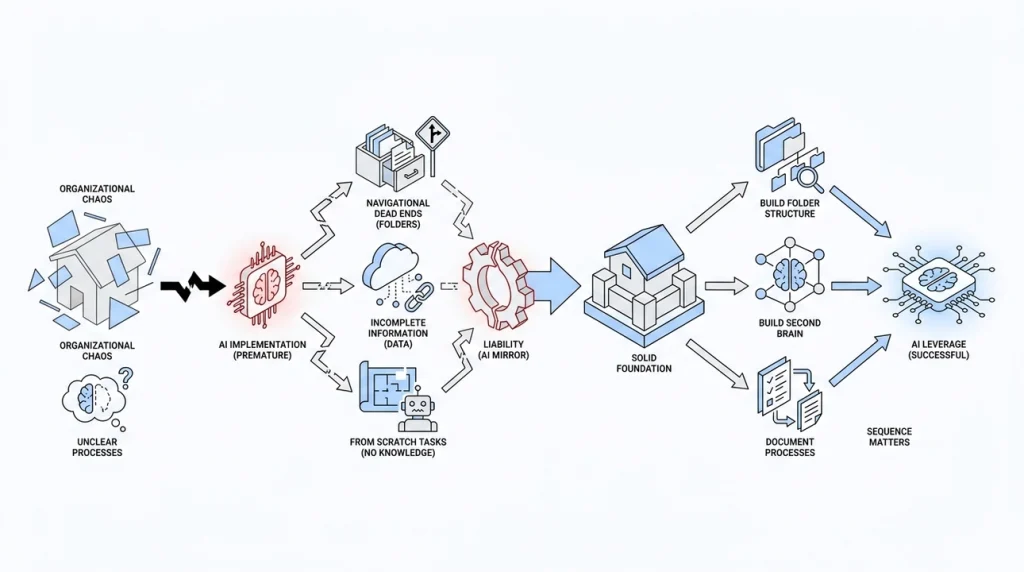 before they understand their own operations. They see the demos, they see the potential, and they want to get there immediately. I get it. The capabilities are genuinely exciting.
But what happens when you skip the foundation is that AI becomes a mirror for your disorganization. Unclear folder structures become navigational dead ends for your agents. Scattered client data means the AI is always working with incomplete information. Undocumented processes mean every task starts from scratch with no institutional knowledge to draw from.
The result is that AI stops feeling like leverage and starts feeling like a liability, and people conclude that it does not work for their agency. It does work. But it only works when it has something solid to build on.
Get your house in order first. Build the folder structure. Build the second brain. Document your processes. Then bring in the AI. That sequence matters more than any specific tool or model you choose, and it is the thing I wish someone had told me before I started.
Most agencies are still playing the old game. They are chasing domain authority scores and domain ratings, treating those numbers like they are the secret to ranking, and paying a premium for links based entirely on what Moz or Ahrefs says a site is worth. We get it. Those metrics felt reliable for a long time. But the algorithm that rewarded that kind of thinking has fundamentally changed, and the agencies that have not changed with it are quietly losing ground while wondering why their results keep sliding.
Here is the hard truth: Google does not care about your DA. It never did in the way the SEO industry convinced itself it did. What it cares about, and what it is getting dramatically better at understanding, is meaning. Context. Relationships between things. And that shift changes everything about how we should be approaching SEO, especially for local businesses.
Domain authority and domain rating are third-party proprietary metrics. They were created by toolmakers to approximate link value, not to reflect how Google actually evaluates the web. They are useful for some things, but they have never been a direct signal in Google's ranking systems. Using them as the primary criteria for link acquisition is, at best, a loose proxy for what actually matters. At worst, it is a very expensive way to buy signals that algorithms are increasingly trained to discount.

The SEO industry latched onto these metrics because they gave people something measurable to point to. Clients wanted proof. Agencies wanted accountability. And so everyone started optimizing for numbers that were never actually part of the system they were trying to influence. That feedback loop has been running for years, and it has produced an entire marketplace built around selling links on the basis of vanity metrics rather than actual relevance.
The problem is that Google's understanding of language, context, and entities has matured significantly. Its natural language capabilities are now sophisticated enough to recognize when a link comes from a source that has nothing to do with the topic of the page it is pointing to. A high-DA site in a completely unrelated industry is not the endorsement it once appeared to be. The signal is weak because the context is wrong, and the algorithm knows it.
We think about SEO differently at Semantic Links, and that difference is not cosmetic. It is foundational.
SEO, as we see it, is the practice of establishing and strengthening associations. Specifically, the associations between a brand and the products or services it provides, and between that brand and the locations or geographic areas where it operates. The job of a modern SEO strategy is to help algorithms recognize and trust those associations, consistently and across multiple surfaces, so that when someone is searching for what that business offers, the algorithm connects the dots.
That is a very different mental model than “push link equity from high-authority domains.” It is not about manipulating a score. It is about building a verifiable pattern of meaning.
Think about what an algorithm is actually trying to do. It is trying to understand what a business is, what it does, and where it does it, so it can serve that business up in the right context. Every signal we send should be contributing to that understanding. If our signals are coming from sources that have no topical or geographic relationship to our client's business, we are not reinforcing anything. We are creating noise.
This is where the strategy becomes concrete, and where most link building falls completely short.

To strengthen the association between a brand and its relevant entities, we need three things working together. First, the brand name needs to appear in close proximity to the service or product terms that describe what the business does. Second, it needs to appear near the location or geographic terms that define where the business operates. Third, that content needs to be published on sources that are themselves relevant to the same topic or geography.
That last piece is the one most link building services get wrong. They find a site with a decent domain rating and place a link there, regardless of whether that site has any meaningful topical connection to the client's industry. The link exists, but it does not reinforce anything. It does not help the algorithm build a clearer picture of who the client is or what they do.
What we do at Semantic Links is build what we call a verifiable truth layer. Every piece of content we publish, every brand mention we place, every citation we build, is designed to come from a source that the algorithm can recognize as relevant to the same topic, the same industry, or the same geographic area as the business we are promoting. The source validates the association. The relevance of the source is what gives the signal meaning.
When a brand name appears alongside service entity terms and location entity terms, inside content published on a topically aligned source, the algorithm receives a clear and coherent signal. It is not just a link. It is confirmation. And when that pattern repeats consistently across multiple relevant sources, it compounds. The algorithm does not just notice the brand; it understands it.
Search has expanded far beyond the ten blue links. People are finding businesses across a growing number of surfaces, from AI-generated answers to map packs to voice search to social discovery. The thread connecting all of these surfaces is that they are all powered by language models and entity-based understanding. They are all asking the same underlying question: what is this brand, what does it do, and where does it do it?
If your SEO strategy cannot answer that question clearly, you are invisible on all of those surfaces. If it can answer it clearly, and if the answer is reinforced by a consistent, relevant body of signals, you earn visibility not just on one surface but across many.
This is why the old metric-chasing approach is not just inefficient; it is strategically misaligned. You can buy all the high-DA links you want, but if they are not contributing to a coherent picture of your client's brand, its services, and its geography, you are spending money to create confusion, not clarity.
The agencies that are winning for their local clients right now are the ones that have made this shift. They are not asking “what is the DR of this site?” They are asking “does this source have a meaningful topical or geographic relationship to my client's industry and market?” That question leads to better links, lower costs, and results that actually hold up over time.
SEO has always been about helping search systems understand something. What has changed is how sophisticated those systems have become, and how precisely they can now evaluate whether the signals we send actually mean what we claim they mean.
Chasing domain authority was never really about understanding. It was about approximation. And approximations that do not reflect how the algorithm actually works will keep getting less effective as the algorithm keeps getting smarter.
The shift we are describing is not a trend. It is the direction everything is moving. Algorithms are getting better at understanding brands, services, locations, and the relationships between them. The SEO strategies that survive and thrive are the ones built around the same thing the algorithm is built around: meaning, context, and association.
That is what we build at Semantic Links. Not just links. A verifiable, relevant, coherent signal environment that helps the algorithm understand exactly who your client is, what they do, and where they do it. That is what moves the needle now, and it is the only thing that will continue to move it as search keeps evolving.
There is a pattern that shows up on almost every agency sales call. A prospect comes in frustrated. Their client campaigns have gone stagnant. Rankings that used to climb are flat. Retainer renewals are getting harder to justify. And the instinct is usually to do more of the same: more guest posts, more niche edits, more links from sources with impressive-looking third-party metrics.
The problem is not effort. The problem is the model itself.
For years, link building in the local SEO world ran on a fairly predictable logic. Find a site with a decent DA or DR score, secure a placement, and expect some lift. Paid guest posts and link insertions became commoditized services because that logic seemed to hold. Agencies built their fulfillment stacks around it. Clients paid for it.
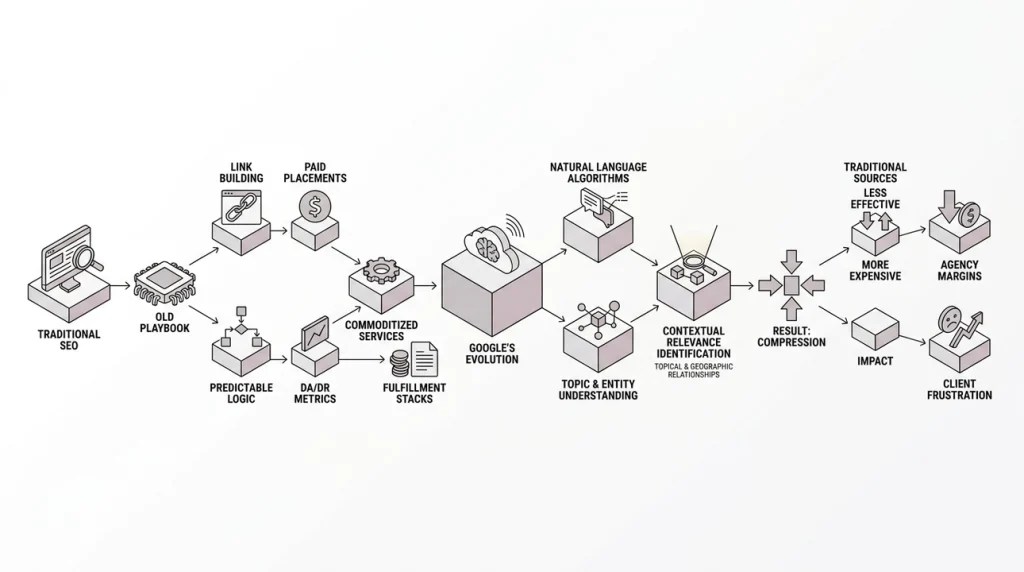
But Google has not been standing still. Its natural language algorithms have gotten significantly better at understanding topics, entities, and the relationships between them. That means Google is also getting better at identifying when a link comes from a source that has no meaningful topical or geographic relationship to the site it points to.
The result is that those traditional link sources are becoming less effective at the same time they are becoming more expensive. That is a compression on both sides. Agency margins shrink, retainer fees creep up, and clients grow frustrated when results do not materialize the way they used to.
Leaning on Moz or Ahrefs metrics to justify a link placement is not the same as understanding whether Google will actually assign value to it. Those tools measure what they measure. They do not tell you whether a link source is relevant to a tree service company in Charlotte or a plumber in Phoenix.
Here is where the conversation usually shifts for agency owners who are open to a different approach.
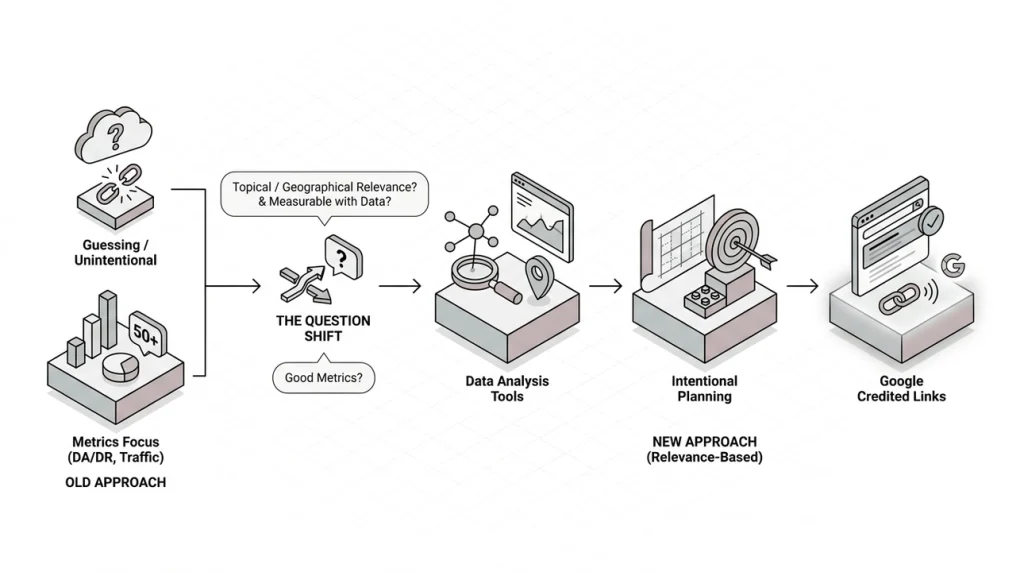
The question worth asking is not “does this site have good metrics?” It is “is this source topically or geographically relevant to the target?” And the follow-up question is equally important: can that relevance be determined with data before the link is ever built?
The answer is yes. Current tools and applications make it possible to analyze what types of links a site actually needs, based on the competitive landscape and the relevance signals that are already moving the needle in a given niche or geography. That is the difference between guessing and building with intention.
When this kind of analysis gets walked through with agency owners on a sales call, the response is consistent. It opens their eyes. Not because it is a complicated idea, but because it reframes the entire decision. Instead of asking “how many links can we get for this budget,” the right question becomes “which specific types of links will actually be credited by Google for this particular client.”
That shift in framing changes everything about how link building gets planned and executed.
The core of a relevance-based link building strategy comes down to a few principles.
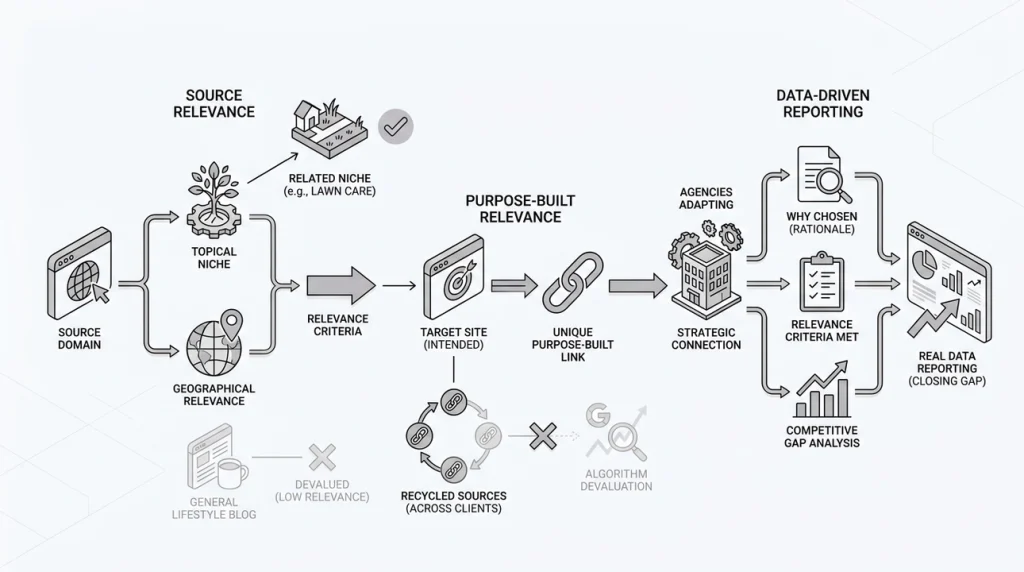
Source domains should be topically related to the niche of the target site, geographically relevant where applicable, or both. A link about tree care from a site that covers lawn and landscaping topics carries more weight than a link from a general lifestyle blog with a high DR score. That is not an opinion. That is how Google's understanding of topics and entities works in practice.
Beyond source relevance, the approach requires that each link source be selected with its intended target in mind. The model of recycling the same link sources across dozens of unrelated clients is exactly what Google's evolving algorithm is designed to devalue. Purpose-built relevance is the differentiator.
The agencies that are adapting to this shift are the ones showing clients real data during reporting, not just a list of placements. They can point to why each link was chosen, what relevance criteria it met, and how that connects to the competitive gap they are trying to close.
When a local SEO campaign stops moving, the temptation is to add more volume. More content, more links, more activity. But stagnation is usually a signal about quality and relevance, not quantity.
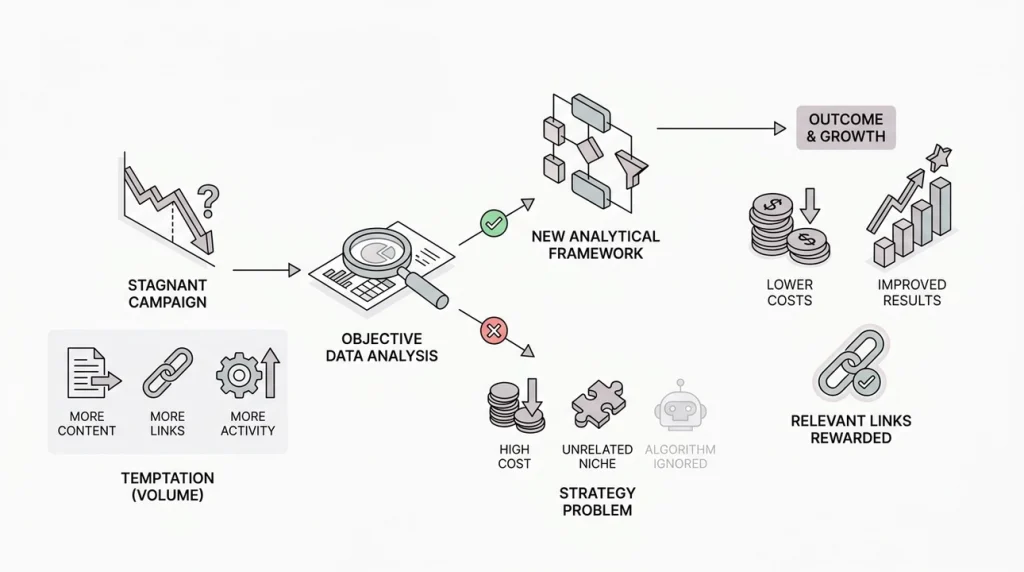
An agency owner who is willing to look at the data objectively will often find that their current link sources are expensive, loosely related to the client's niche, and increasingly ignored by the algorithm they are trying to influence. That is not a link building budget problem. That is a link building strategy problem.
The good news is that the correction does not require starting from scratch. It requires a better analytical framework for deciding which links are worth building in the first place. When that framework is applied, costs tend to go down because irrelevant placements stop eating up budget, and results tend to improve because the links that do get built are the ones Google is prepared to reward.
That is the core of what has changed. Google is better at understanding what is relevant. The agencies that build their fulfillment strategies around that reality are the ones that will hold onto clients and grow. The ones that keep buying overpriced placements on unrelated source domains are working against an algorithm that gets sharper every year.
The data is available. The tools exist. The only thing left is the willingness to use them.